
Role-based access models don’t “just” break down, they do something a lot worse. They create a false sense of control that becomes increasingly dangerous as an organization scales. In large enterprises, the reality is often sobering – the more structured the model looks on paper, the less anyone actually understands who has access to what in practice.
What starts as a governance framework often changes into a security theater. While the spreadsheets show clean hierarchies, they act as a veil for privilege sprawl, manual “one-time” exceptions, and silent risk accumulation.
The core issue is that traditional RBAC centralizes decisions in a way that cannot keep up with a decentralized, fast-moving business reality. Instead of protecting the perimeter, a static model eventually turns into a liability engine – hiding the very gaps that audits and attackers are looking for.
In this article, I’ll move past the “perfect design” phase to look at the mechanical reality of why access governance fails and what the business risk actually looks like.
In a nutshell:
- Static RBAC models don’t fail because the concept is flawed, but because organizations change faster than roles can keep up.
- Role bloat, exception creep, and orphaned groups gradually erode visibility into who has access to what, increasing both security and compliance risk.
- Legacy IAM environments make the problem worse by hiding business logic in scripts, AD attributes, and undocumented processes.
- Effective access governance requires continuous role reviews, clear ownership, and monitoring of exceptions – not a one-time RBAC design.
- Before replacing your IAM platform, determine whether the real issue is role design, governance processes, or the technology itself.
Why real organizations are too messy for static roles
Static role models were never a bad idea. They were designed to bring order to the chaos of manual access. For regulated sectors like finance and healthcare, the promise of consistency made Role-Based Access Control (RBAC) the gold standard. However, reality is rarely as clean as a spreadsheet.
The bloat of “just in case”
In an access governance large enterprise setting, role-based access control challenges often stem from human nature. When a team of a thousand needs a tool for only two specialists, the default move is to grant it to the entire group. This over-provisioning happens because granular management is exhausting. It is easier to bloat a role than to manage an exception, leading to “access creep” where roles become heavy with unnecessary permissions.
Motion vs. logic
Roles are typically designed around static job titles, but people in large firms are in constant motion. Employees rotate through teams, cover for colleagues, or get promoted sideways. This fluidity quickly outpaces an IT team’s ability to update identity logic. Often, there isn’t a full-scale IAM team – just one person trying to keep up while others simply follow the path of least resistance. The system eventually falls apart because the visibility of who has access to what is lost.
This disconnect creates “orphaned” data. For example, a client might have 12,000 groups but only 200 owners. This leaves over 11,000 groups in limbo, untouched because no one dares delete what might be a 15-year-old integration.
Governance must live
The biggest mistake is treating IAM like a “one-and-done” application install. Organizations change; a “Developer” role might split into Front-end and Back-end, or merge back into a generalist title six months later. Without a central IGA platform to handle access reviews and certification campaigns, licenses and permissions remain attached to users long after the need expires. This leads to depleted license pools and unnecessary costs.
To maintain security, a Microsoft Identity Manager replacement access governance strategy must embrace the “exception.” If exceptions become the rule, it is time for a cleanup. True security requires a living model that monitors how many roles are assigned outside the standard and adjusts to the messy, real-world flow of the business.
For expert guidance on navigating these transitions, read about preserving security and compliance in a post-MIM world.
Why static role models seemed like the right answer
The appeal of static role models was rooted in a real need for order. For any access governance large enterprise, the initial promise of RBAC was simple, to streamline onboarding, automate approvals, and significantly reduce manual labor. In highly-regulated sectors, this was a survival strategy for passing audits.
The safety net of automation
Static roles were a response to the high stakes of manual identity management. Human intervention is prone to catastrophic errors – like accidentally deleting a CEO’s active mailbox because it appeared “inactive” on a spreadsheet. The goal was a system that “knew” better than a human, cross-referencing data to ensure access was grounded in business reality rather than guesswork.
The “set and forget” fallacy
The failure wasn’t the concept of the “role,” but the assumption of stability. There was a belief that access needs would stay still long enough for the model to remain accurate. In reality, business moves faster than IT’s capacity to refactor roles.
Why static access roles break in real enterprise environments
The breakdown of static roles is rarely just about quantity; it is a failure of lifecycle management and data integrity. Role-based access control challenges peak when AD attributes are filled without clear purpose, or documentation remains scattered across disconnected files. When key IAM experts rotate out, they leave behind “lemming” administrators who merely click through tasks without understanding the underlying logic.
Visibility becomes the first casualty. In a typical access governance large enterprise, thousands of “orphan” groups exist without owners. These are often relics of historical projects that crossed departmental boundaries, leaving IT to hunt through logs to determine if an account is safe to delete.
Furthermore, temporary exceptions inevitably become permanent fixtures. These “exceptions” are a primary signal of a decaying model. Modern IGA tools are essential to identify access granted outside of standard roles, especially when “Developer” titles are applied broadly to teams with vastly different technical needs. Without a MIM replacement access governance strategy that prioritizes dynamic discovery, your system reflects ancient history rather than current reality.
The maintenance problem is the real failure point
Static models fail because they are treated as one-time deliverables rather than living systems. Once the original architects depart, IT inherits a “black box” of undocumented AD attributes. Without clear ownership, thousands of groups become orphans that no one dares delete.
Consequently, access reviews and certification campaigns degrade into “rubber stamping”. Managers, viewing these as distractions, often bypass the process entirely. This neglect causes silent drift, where roles become bloated with “just-in-case” permissions. These hidden dependencies remain invisible until a migration or audit exposes the rot. To survive, governance must be active, continually questioning if a role still reflects business reality.
Why the problem is bigger in legacy IAM environments
In legacy environments, the greatest threat is “hidden logic” buried within Active Directory attributes or scattered scripts that no one remembers. Over decades, as dozens of administrators rotate through an access governance large enterprise, the institutional knowledge of why specific configurations exist simply evaporates.
Clients are often blindsided by the scale of the “orphan” problem. Even when owners were originally assigned to technical accounts or groups, those individuals frequently left the firm years ago without the system requiring a successor.
What the business risk actually looks like
For IT directors and CTOs, the failure of static roles translates directly into financial and operational liabilities. When the gap between the official access model and reality grows, the organization faces four critical risks:
- Financial waste via license bloat. Over-provisioning occurs when entire teams get broad permissions to avoid the complexity of granular management. This creates “access creep,” where the enterprise pays for thousands of licenses that are never used.
- Invisible SoD conflicts. Without dynamic governance, Segregation of Duties (SoD) conflicts remain hidden. These risks often only surface during an investigation or after a significant breach has occurred.
- The “shadow” audit trail. Manual access reviews and certification campaigns often produce weak evidence trails. If a manager “rubber stamps” a review just to clear their inbox, the resulting audit report is compliance theater, not security.
- The analysis trap. Rushing the foundation is a high-stakes gamble. Often, a client assumes the analysis phase will take 3 weeks, and a provider agrees without highlighting the risks. In reality, a thorough deep-dive into an access governance large enterprise might require 9 weeks. When analysis is cut short, the resulting solution fails to meet actual needs – costing far more to fix post-deployment than the extra six weeks of initial research would have.
Modern MIM replacement access governance platforms like One Identity or Microsoft Entra ID Governance [GU2] mitigate these risks by providing clear “access origin” reports. They answer the fundamental questions – who has access, and why – that static models simply cannot.
What to put in place instead. A living access governance model
To solve role-based access control challenges, organizations must shift from static structures to a living governance model. A modern access governance large enterprise strategy relies on continuous verification rather than a one-time setup.
Key components of a living model:
- Meaningful certification campaigns. Move away from calendar rituals. Reviews should be triggered by actual business changes or risk shifts to make sure access reviews and certification campaigns remain relevant.
- Centralized policy ownership. The IAM team should oversee the creation of all new roles. Giving application owners too much autonomy often leads to inconsistent logic and sprawl.
- Access origin analytics. Use IGA tools to distinguish between access that was inherited, formally requested, or exists as an unjustified exception.
- Cyclical role hygiene. Regularly audit not just whether a user needs a role, but whether the role itself still makes sense within the current organizational structure.
- Exception monitoring. Track how often “out-of-bounds” access is granted. A spike in exceptions is a primary signal that your underlying role model needs a redesign.
Any structural shift – from creating a new department to rebranding job titles – must be consulted with the IAM team. Synchronizing HR and IAM processes ensures that permissions evolve alongside the company rather than accumulating as technical debt. Each change should automatically trigger a verification of the affected roles to prevent the model from becoming obsolete.
Role redesign, governance cleanup, or full modernization. How to tell which problem you actually have
Before jumping into a new tool, it is critical to determine if the issue is the role catalog, the process, or the platform itself. Moving broken processes to a modern platform only results in “expensive chaos.”
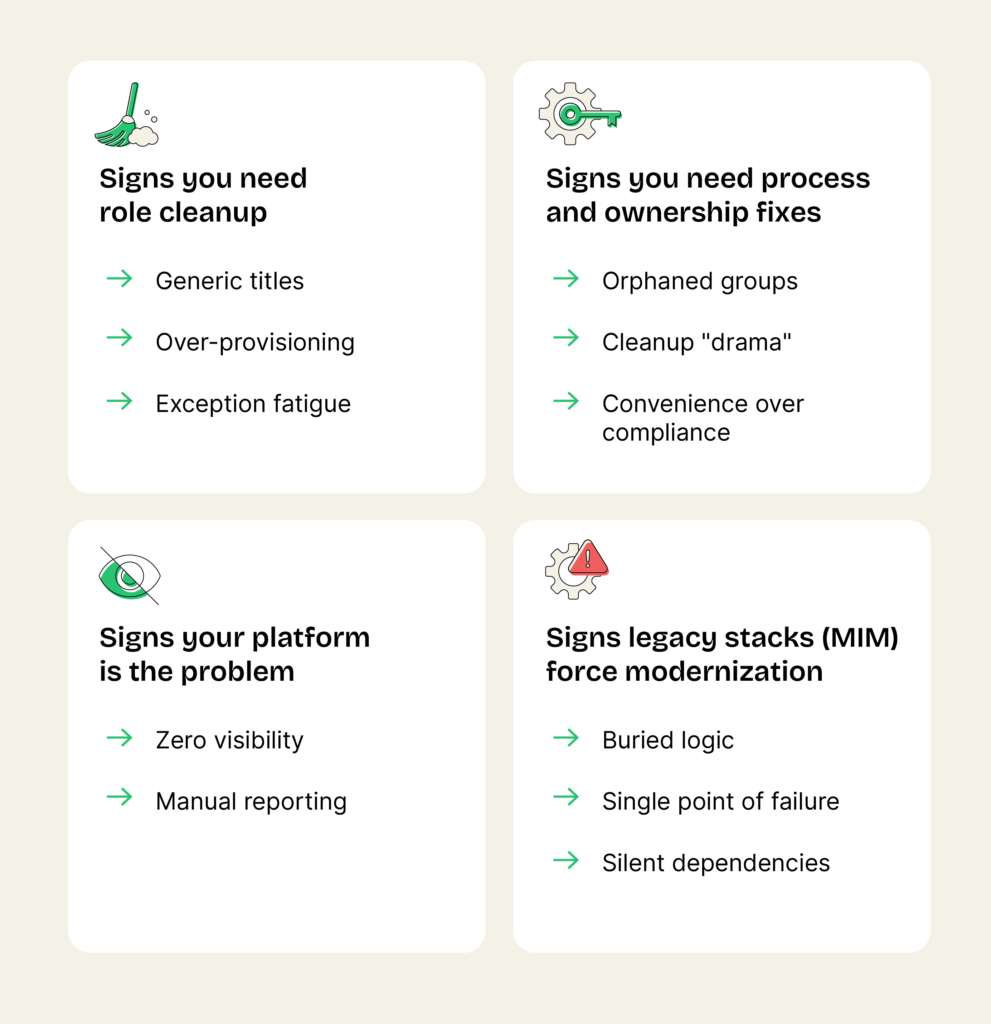
1. Signs you need role cleanup
- Generic titles. Users share broad titles (e.g., “Developer”) despite requiring vastly different technical tools.
- Over-provisioning. Access is granted to a team of 1,000 because two specialists needed specific permission.
- Exception fatigue. Manual requests and “out-of-bounds” exceptions are appearing more frequently than standard role assignments.
2. Signs you need process and ownership fixes
- Orphaned groups. You have thousands of groups or technical accounts, but only a fraction have documented owners.
- Cleanup “drama”. Reclaiming unused licenses or blocking inactive accounts triggers high-level organizational pushback rather than being a standard security procedure.
- Convenience over compliance. High-risk practices like leaving accounts active during long leaves are maintained solely to avoid the “hassle” of re-provisioning.
3. Signs your platform is the problem
- Zero visibility. You cannot instantly see “Access Origin” (why a user has a permission) or generate an “Out-of-Bounds” report without manual data extraction.
- Manual reporting. Compliance reports require fragmented database exports rather than being available “out of the box.”
4. Signs legacy stacks (MIM) force modernization
- Buried logic. Critical identity logic is “hard-coded” into AD attributes or scripts that no one currently on the team understands.
- Single point of failure. The system is a “black box” managed by one Principal Engineer [GU3] whose departure would leave the firm in a state of total knowledge loss.
- Silent dependencies. You are afraid to migrate or block accounts because systems have communicated silently for 15 years, and no one knows what might break.
What better tooling changes, and what it does not
Modern Identity Governance and Administration (IGA) tools move away from the “black box” nature of legacy systems by providing native, automated visibility. Tools like One Identity or Entra allow you to instantly identify “Access Origin” – showing whether a user gained a permission through a specific role, a manual request, or a lingering exception. Unlike manual processes that lead to organizational “dramas,” these systems automate attestation and role enforcement by design.
However, the right solution depends entirely on your technical fit and internal maturity. If an organization is deeply rooted in Microsoft technologies and Active Directory, moving to One Identity or Entra often offers a much smoother transition than a high-complexity platform like SailPoint.
Process modernization: The DORA reality
Migration is the perfect opportunity to fix outdated habits that have become liabilities.
For instance, the common practice of leaving accounts active during long leaves for the sake of “convenience” is no longer just a security risk. It is now a compliance failure. Under regulations like DORA (Digital Operational Resilience Act), financial entities must implement strict access controls and identity management to ensure resilience. This includes:
- Automating lifecycle management. Ensuring accounts are locked or permissions revoked when users are inactive or leave the organization.
- Segregation of Duties (SoD). Using IGA tools to prevent and flag conflicting permissions automatically.
- Audit-ready reporting. Moving from manual spreadsheets to “out-of-the-box” analytics that prove who has access and why.
Ultimately, tools are only as strong as the governance behind them. The IAM team must remain the “gatekeeper,” ensuring that application owners cannot bypass the system to add roles manually. If you simply move a broken, manual process to a modern platform, you haven’t fixed the problem, but made it more expensive.
Access governance is not a one-time design exercise
Access governance fails because it is often treated as a finished project rather than a living control system. In large enterprises, frozen role diagrams cannot keep pace with operational reality. Static models inevitably decay into a “black box” of undocumented logic and orphan accounts.
True resilience requires shifting from one-time design to active oversight. If your access model no longer reflects daily operations, a diagnostic review is the essential first step.
Assess your current drift today to determine if you need a targeted role cleanup, a governance redesign, or full platform modernization.
Identity-based security incidents now affect exactly half of all organizations. From my experience, the correlation is undeniable. Immature programs that rely on manual processes see a higher incident rate than those with mature governance.
Compromised credentials and misconfigurations drive these breaches, costing unprepared companies millions. However, those prioritizing access recertification best practices save up to $1.9 million per incident compared to manual-heavy organizations.
This article explores why most access reviews remain mere theater – and how to turn them into a functional defense.
In a nutshell:
- Access recertification confirms that users still need the permissions assigned to them.
- Clear ownership, business context, and accurate entitlement data help reviewers make informed access decisions.
- Automation keeps certification campaigns consistent, reduces manual work, and makes recurring reviews easier to manage.
- Review frequency should reflect the level of risk, with sensitive access receiving more attention than standard user permissions.
- Regular certifications help remove unnecessary access. They also strengthen least privilege and support security and compliance objectives.
Access recertification best practices (quick answer)
If your access reviews feel like a checkbox exercise, focus on these core practices:
- run smaller, risk-based review campaigns
- reduce manual steps through automation
- provide clear business context to reviewers
- eliminate unnecessary roles and complexity
- integrate as many applications as possible, directly with your IGA
The rest of this article explains why these matter and how to implement them.
Why access reviews fail without proper recertification practices
Many organizations treat access reviews like a high-stakes performance – plenty of movement and a lot of noise, but very little substance. Despite the clear risks of over-privileged accounts, the reality is that identity governance often lacks the maturity needed to be effective. Identity-related incidents now cost organizations millions. This is where weak IAM practices translate directly into financial impact.
The illusion of maturity
A startling gap exists between the necessity of robust Identity and Access Management (IAM) and its actual implementation. According to a 2024 Ponemon Institute study, only 45% of organizations have an established IAM program or strategy. This absence of a formal framework means access management is frequently shuffled off to general IT staff who lack specialized expertise.
This “jack-of-all-trades” approach is further crippled by a talent shortage; roughly 52% of organizations cite a lack of in-house specialists as a primary barrier to securing identities.
Skipping the fundamentals
The most damning evidence that access reviews are often mere theater is the number of companies skipping them entirely. The same Ponemon research reveals that 26% of respondents perform no periodic access reviews or certifications whatsoever. When reviews do happen, the methods are often archaic:
- 23% still rely on manual spreadsheets.
- 31% use custom, disconnected in-house workflows.
- Only 20% utilize a dedicated IAM identity governance platform.
Why manual access reviews fail without automation
Continuing to rely on manual labor in 2026 is a choice to remain vulnerable. The 2025 State of IGA Survey Report highlights that 84% of organizations still lean heavily on manual processes, while a mere 6% have achieved full automation. This inefficiency has a literal cost. Manual reviews require an average of 149 person-days, compared to just 55 days when user access review automation is implemented.
This is exactly where user access review automation stops being optional and becomes necessary.
Why user access review automation is no longer optional
Manual access reviews no longer scale with the complexity of modern environments. As an organization grows, the number of users, roles, and connected systems increases fast. Spreadsheets and email-based approvals quickly become unmanageable. This leads to longer review cycles and delayed decisions. As a result, critical access remains active far longer than it should.
This delay creates risk. The longer excessive or unnecessary permissions remain in place, the larger the attack surface becomes. In many cases, access that should have been revoked weeks earlier stays active simply because the process cannot keep up.
User access review automation changes this dynamic. By removing manual steps, an organization can:
- Shorten review cycles to close windows of vulnerability faster.
- Reduce reviewer fatigue by presenting only the most relevant data.
- Ensure consistent application of security policies.
- Eliminate the gap between a revocation decision and its actual enforcement.
Automation does more than just improve efficiency; it restores control. Instead of chasing completion metrics, teams can focus on verifying whether access is still justified. This is a crucial shift away from rubber stamp access certification and toward a process that actually reduces risk.
Why access reviews become a compliance checkbox
The scope of compliance is exploding. 91% of identity leaders have seen the scale of their reviews increase since 2022, and 99% of companies now conduct reviews primarily to satisfy regulatory frameworks.
However, when the focus is solely on satisfying auditors, the process becomes a “checkbox” exercise. This leads to the rubber stamp access certification phenomenon, where the goal is completion rather than security.
With 82% of leaders reporting that satisfying auditors requires high levels of effort, the exhaustion is palpable. Without applying clear access recertification best practices, organizations will continue to drown in paperwork while orphaned accounts and excessive entitlements – found in 98% of reviews – remain a wide-open door for attackers.
Why IAM programs stall even with good intentions
Even when organizations recognize the strategic importance of Identity and Access Management, a secondary hurdle often leads to a “white flag” mentality. The challenge lies in a specific hiring paradox that leaves even well-funded programs in a state of stagnation.
Building a modern, secure identity system requires the skills of an elite architect, someone capable of designing a “Formula 1” infrastructure. However, once that system is live, a disconnect appears.
High-level builders are rarely interested in the mundane, repetitive tasks of daily administration or troubleshooting MFA tickets. They are driven by high-stakes problem-solving, not the maintenance of a steady state.
The maintenance trap
This reality leaves leadership facing two equally risky scenarios:
- The retention risk.
Paying a premium salary to an overqualified expert who, feeling underutilized by routine tasks, is likely already looking for the next challenge. - The capability gap.
Handing over a sophisticated, high-performance architecture to a generalist team that lacks the specialized knowledge to manage it.
This is the equivalent of handing a Formula 1 car to a driver who only knows how to navigate a standard sedan. The intentions are good, but the operational reality creates a dangerous vulnerability. When the team responsible for user access review automation or complex IAM workflows doesn’t fully grasp the underlying architecture, the system slowly degrades.
Eventually, the lack of specialized oversight leads back to the very “theater” previously described, where the complexity of the tools overwhelms the staff, and access recertification best practices are abandoned in favor of whatever is easiest to manage.
What happens when access reviews are just theater
The accumulation of these structural failures leads to consequences that are both technically dangerous and financially staggering. When access reviews are performed as theater, the “stage” isn’t the only thing at risk – the entire organization becomes a target for exploitation.
Privilege creep and hidden access risk
The most immediate technical fallout is persistent privilege creep. Without a mature approach to access recertification best practices, users and former employees gradually accumulate permissions that far exceed their current roles.
Because reviewers often lack the necessary context regarding why access was originally granted or how it is being used, the default action is rarely revocation. This creates a massive, ever-growing attack surface.
Manual campaigns, which were intended to shrink this footprint, instead become the mechanism that allows orphaned or excessive permissions to linger indefinitely, directly violating the principle of least privilege.
The financial impact of poor identity governance
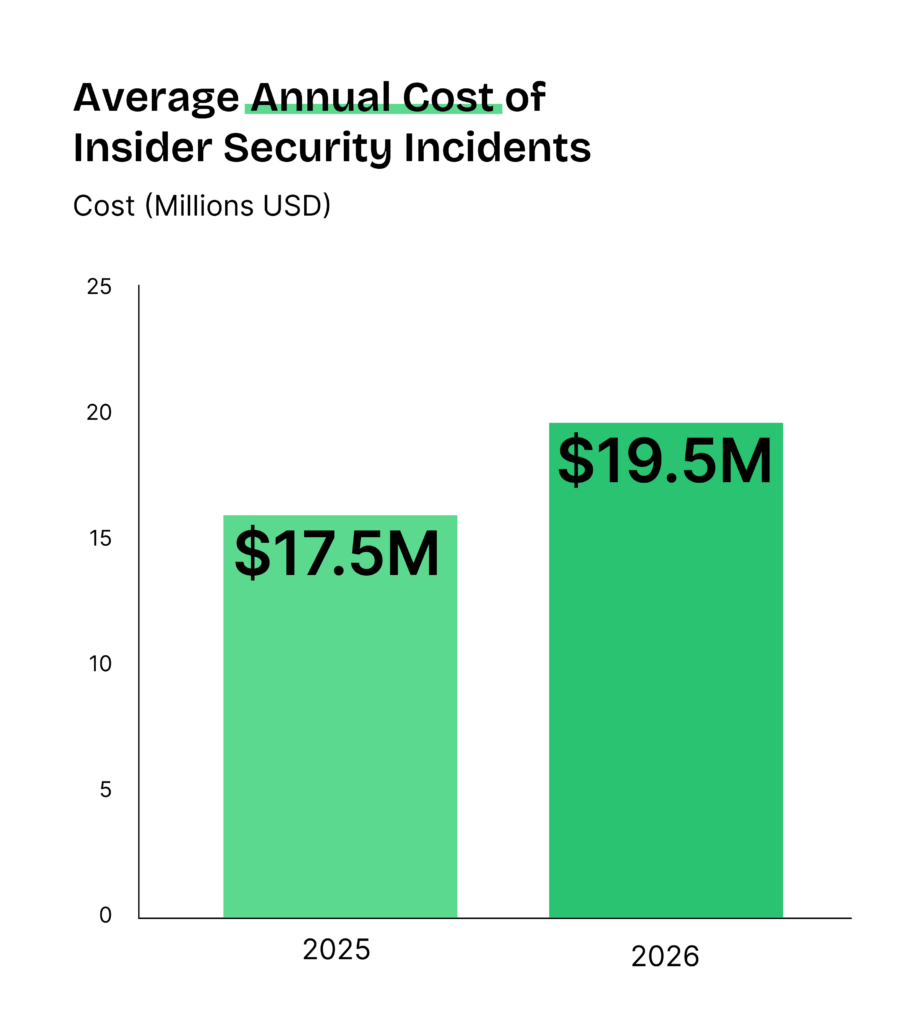
The Ponemon report highlights a sharp upward trend in the financial impact of identity-related vulnerabilities.
The total average annual cost of insider security incidents has reached US$19.5 million. This represents a $2 million increase compared to 2025.
This financial drain isn’t just the result of deliberate insider abuse. It is the price of an unmanaged environment where oversight is inconsistent and slow.
But what might be the biggest source of anxiety, in my opinion, is how long it takes to contain such issues – 67 days on average.
False sense of security in IAM programs
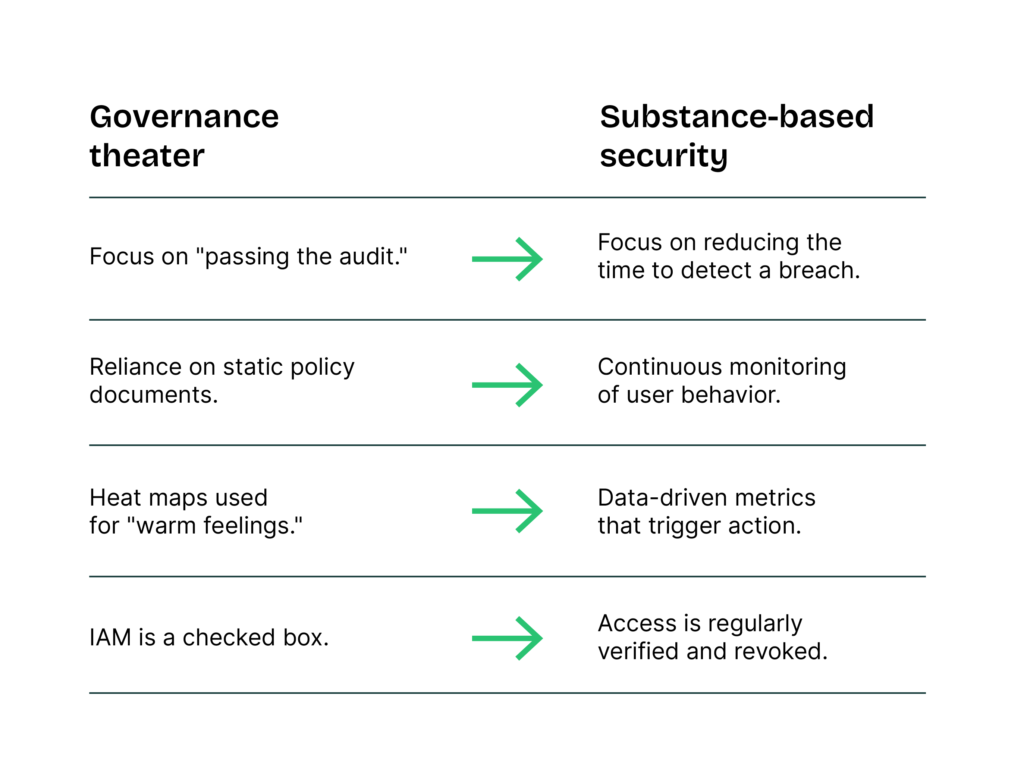
The core of the issue lies in the distinction between “compliance” and “actual security.” While the artifacts of governance like signed policies provide a feeling of safety, they often fail to address the underlying risks.
I think that it’s more helpful to look at the habits that create a false sense of security than to study complex statistics.
- Organizations often prioritize “passing the audit” by producing documents, rather than verifying if those documents reflect daily operations.
- Having an Identity and Access Management (IAM) system is frequently treated as a “set and forget” solution. In reality, most breaches happen because valid access is abused, not because the system is missing.
- Stakeholders see the “impressive” reports, but the growing attack surface – like unmanaged credentials or stale access permissions – remains hidden until a breach occurs.
How human error turns into major incidents
Operational disruptions often hide behind the label of “technical glitches,” but identity governance failures usually sit at the root. When organizations grant employees, developers, or contractors broad access rights such as full administrative control over cloud storage or production databases they eliminate the margin for error.
Neglecting access recertification best practices transforms a simple mistake into a catastrophe. Without a safety net, a single user with excessive privileges can trigger several high-stakes scenarios:
- A developer accidentally drops a critical database table during a routine test because they retained unnecessary write/delete permissions.
- An employee overwrites or deletes shared files because the system never revoked their access after a project ended.
- A user misconfigures a storage bucket or security policy, leading to the public exposure of sensitive data.
These actions rarely stem from malicious intent. Instead, human error finds a foothold in a lack of oversight. When managers treat reviews as a “rubber stamp” exercise, they fail to ask if a user truly needs the power to modify core resources.
A mature IAM program creates a buffer for the team. By tailoring access strictly to current requirements, an organization reduces the “blast radius” of a single accidental keystroke. Transitioning to user access review automation ensures that these guardrails remain in place, protecting the business from its own administrative debt.
Access recertification best practices in practice – a detailed explanation
Moving from “theater” to a functional security posture requires a shift in how the organization engages the reviewers themselves. I often see teams struggle because the process itself remains opaque and exhausting, not because they lack the will.
Defeat reviewer fatigue
The most common enemy of a successful audit is “reviewer fatigue.” When managers face a mountain of requests with no clear end in sight, the temptation to engage in rubber stamp access certification becomes overwhelming.
To fight this, I recommend moving away from the “one-size-fits-all” annual campaign.
Instead, a more effective strategy involves tiering the reviews based on risk. Organizations should run frequent, small-scale campaigns for privileged roles while reserving broader, lower-risk certifications for an annual or bi-annual cadence.
Breaking the work into manageable bites prevents the “check-the-box” mentality and keeps the focus where it matters most, which is on high-stakes access.
Solve the context gap
The “artifact trap” often stems from a lack of clarity. If a reviewer sees a role named APP_user_1232_new, they have no way of knowing what permissions that role actually grants. Without business-friendly descriptions and clear role naming conventions, the review process remains a guessing game.
I advocate for a “context-first” approach to form design. To make informed decisions, a reviewer needs more than just a cryptic ID; they need actionable data points integrated directly into the review interface.
Use intelligence and context
Modern tools provide the necessary telemetry to turn a blind guess into an informed decision. For instance:
- Platforms like Entra ID Access Review offer machine learning (ML) capabilities that suggest whether to approve or deny access based on what similar users in the organization possess.
- Showing the date of the last login or recent activity – a feature also available in robust systems like One Identity Manager – allows a manager to see instantly if a permission remains in use.
- Mapping technical entitlements to clear, human-readable business functions ensures the person signing the document actually understands what they are authorizing.
Reduce role complexity
A bloated role catalog is often the silent killer of an effective IAM strategy. In my experience, organizations often mistake technical groups for business roles. I recently came across a situation where a client attempted to transform several hundred individual Workday groups into distinct roles. This level of granularity creates an unmanageable administrative nightmare, it doesn’t provide security.
To move away from this complexity, a strong Digital Advisor or IAM Program Manager must step in and enforce discipline. Successful programs rely on a rigorous role mining process to consolidate access into meaningful, logical clusters.
Often, the biggest hurdle is culture. Experts in the field must develop the ability to say “no” to requests for new roles driven solely by business convenience or “the way things have always been done.”
By resisting the urge to over-complicate the system for the sake of comfort, organizations can implement access recertification best practices that actually scale. Refining the role structure is a prerequisite for successful user access review automation; without it, you are simply automating a mess.
Integrate access reviews with systems
Access reviews only reach their full potential when an organization integrates its applications directly with the governance platform. Without these connections, the “theater” continues. A reviewer might decide to revoke access, but someone (often a Service Desk agent) must then manually execute that change. This lag creates a dangerous window of risk.
Worse, a lack of integration leads to a visibility crisis. Permissions granted manually or “out-of-band” remain invisible to the IAM platform. If the system doesn’t know an entitlement exists, it cannot include it in a review. To counter this, I recommend several high-impact access recertification best practices:
- Prioritize integration. Focus on connecting core applications to the central platform to ensure real-time visibility.
- Structured manual flows. For non-integrated systems, replace fragile email chains with automated Jira tickets to track fulfillment.
- Validation reports. Frequently pull manual reports directly from unlinked applications to cross-reference against the IAM “source of truth.”
- Strategic tooling. Choosing between Cloud (SaaS) or on-prem solutions often dictates integration success; SaaS requires highly structured user data and simplified processes to thrive.
Turning compliance into real security outcomes
To wrap things up, we must realize that a stack of signed compliance reports does not equal a secure environment. If the process is a burden, managers will “rubber stamp” their way through it, and the organization will continue to carry the $1.9 million risk of an identity-based breach.
Security is a living process. The goal of an access review is to ensure that the right people have the right access for the right reasons – and not a single permission more.
Moving from “identity theater” to true governance requires a strategic partner who understands the balance between elite architecture and daily operational reality.
Whether you need to automate your review cycles, perform deep role mining, or integrate complex legacy systems, the experts at QWEY provide the specialized guidance to turn your IAM program into a proactive defense.
Reach out to us today to bridge the gap between compliance and actual security.
There’s a strange tendency for companies to treat HR and IT as if they existed on different planets, keeping their interactions to a minimum. And yet, there’s one area where this “separate worlds” mentality backfires every time, and that’s identity governance.
When there’s friction between business needs and system requirements, the advice is usually “just sync your HRIS to your IGA platform, automate the triggers, and the problem will vanish.” The talk about business and tech departments’ alignment lasts for about five minutes and then the rest of the conversation is about tooling.
Tools are important, but the access problems I’ve seen across companies all stemmed from something broader, i.e., a lack of end-to-end ownership. When a payroll status keeps a terminated employee’s account live for weeks, or an informal “verbal” promotion leaves someone with excessive permissions for months, we are looking at an organizational gap.
To make identity governance work, we have to look past the dashboard and address the silos between the HR and IT teams.
In a nutshell:
- Access management works best when business teams, HR, IT, and security each have clearly defined responsibilities.
- HR, IT, and managers all contribute to the identity lifecycle, from onboarding and role changes to offboarding and access reviews.
- Unclear ownership often leads to excessive permissions, delayed access removal, and compliance gaps.
- A governance model with defined decision-makers and approval paths helps keep access accurate throughout an employee’s time with the organization.
- Successful IAM programs rely on collaboration across departments rather than assigning responsibility to a single team.
Identity governance is now about ongoing supervision
To understand why there are so many misunderstandings or misconceptions around different IGA responsibilities, we have to first realize just how much has changed in the last ten years.
For starters, IGA is no longer solely about provisioning accounts, because the real work now circles around supervision. When we launch an attestation, we don’t stop at “does this person still need an AD account?” Instead, we check every permission the person holds and whether it still belongs there.
This means pulling in as many systems as possible so access requests, monitoring, and revocations happen in one place. This is also where most organizations falter.
Joiner-mover-leaver process ownership isn’t a simple handoff
It’s rarely possible to draw a clear line between HR and IT access management responsibility, because the org chart diffuses accountability. No one owns the outcome. Paradoxically, a “perfect” technical integration between HRIS and IGA can end up masking the underlying mess even further.
The issue grows worse with non-human identities. Service accounts, API keys, bots, and autonomous AI agents often outnumber humans 45:1 or more due to cloud and automation. They don’t follow HR lifecycles, because they appear in code, adapt, escalate rights, and might interact unpredictably.
So, at its core, IGA is about who answers for the access that exists inside systems, and whether anyone can be held accountable when it goes wrong.
The HR Perspective: People-centric but access-blind
HR owns the employee lifecycle, so hiring, promotions, and terminations. They’re the single source of truth for employee data, and they’ve got guidelines on what different roles should be allowed to do. But digging into what entitlements actually look like across twenty different applications? That’s usually not on their radar. They assume access management belongs to IT.
What IGA challenges can this lead to? There are at least a few:
- Payroll vs. access mismatch – someone’s gone, but IGA sees employees as active and keeps the account, creating chaos (or extra costs).
- Retroactive data changes – HR could scrub or archive records after the fact. IGA loses the trail, can’t deprovision cleanly, and ends up with ghosts or duplicates.
- No real visibility into entitlements – HR feeds the people data but doesn’t track or own what those people can really do across systems.
The IT Perspective: Tech-savvy but context-lacking
IT teams run the show on the technical side, so infrastructure, security tools, identity platforms, audits, MFA enforcement, log monitoring, patching, or incident responses.
- They’re experts at making systems work and keeping threats at bay. But they usually can’t answer questions like:What does a specific job need day-to-day?
- Why does a promotion change access in one department but not another?
- What’s the real story with temporary contractors?
The reason is because they’re detached from the business context. IT usually leans on HR joiner-mover-leaver processes they receive from the business.But without speaking to these departments regularly, they often follow policies that are incomplete or outdated. That turns governance into reactive firefighting.
In all honesty, I don’t believe that many IT departments have the conditions to run proactive campaigns, because they handle:
- Massive ecosystem sprawl – Cloud, SaaS, APIs, and exploding machine identities overwhelm their visibility and control.
- Manual-heavy processes – most organizations’ IGA still relies on manual reviews and provisioning, slowing everything down and leaving excessive permissions everywhere.
- Distributed risks – hybrid/remote setups add complexity, because breaches tied to sensitive data exposure, insider threats, and credential misuse grow in spread-out environments.
IT brings serious technical chops, that’s not in question. But they won’t be able to put their technical excellence into work if they don’t know what the real-world business nuance is.
Why no one owns IGA – and why there’s no one to blame
I’d like to make it crystal-clear that the real issue isn’t HR or IT being incompetent. It’s that neither can genuinely be responsible for identity governance alone.
No one has shown HR and IT how to talk to one another about IGA, which builds silos.
We see a