
Role-based access models don’t “just” break down, they do something a lot worse. They create a false sense of control that becomes increasingly dangerous as an organization scales. In large enterprises, the reality is often sobering – the more structured the model looks on paper, the less anyone actually understands who has access to what in practice.
What starts as a governance framework often changes into a security theater. While the spreadsheets show clean hierarchies, they act as a veil for privilege sprawl, manual “one-time” exceptions, and silent risk accumulation.
The core issue is that traditional RBAC centralizes decisions in a way that cannot keep up with a decentralized, fast-moving business reality. Instead of protecting the perimeter, a static model eventually turns into a liability engine – hiding the very gaps that audits and attackers are looking for.
In this article, I’ll move past the “perfect design” phase to look at the mechanical reality of why access governance fails and what the business risk actually looks like.
In a nutshell:
- Static RBAC models don’t fail because the concept is flawed, but because organizations change faster than roles can keep up.
- Role bloat, exception creep, and orphaned groups gradually erode visibility into who has access to what, increasing both security and compliance risk.
- Legacy IAM environments make the problem worse by hiding business logic in scripts, AD attributes, and undocumented processes.
- Effective access governance requires continuous role reviews, clear ownership, and monitoring of exceptions – not a one-time RBAC design.
- Before replacing your IAM platform, determine whether the real issue is role design, governance processes, or the technology itself.
Why real organizations are too messy for static roles
Static role models were never a bad idea. They were designed to bring order to the chaos of manual access. For regulated sectors like finance and healthcare, the promise of consistency made Role-Based Access Control (RBAC) the gold standard. However, reality is rarely as clean as a spreadsheet.
The bloat of “just in case”
In an access governance large enterprise setting, role-based access control challenges often stem from human nature. When a team of a thousand needs a tool for only two specialists, the default move is to grant it to the entire group. This over-provisioning happens because granular management is exhausting. It is easier to bloat a role than to manage an exception, leading to “access creep” where roles become heavy with unnecessary permissions.
Motion vs. logic
Roles are typically designed around static job titles, but people in large firms are in constant motion. Employees rotate through teams, cover for colleagues, or get promoted sideways. This fluidity quickly outpaces an IT team’s ability to update identity logic. Often, there isn’t a full-scale IAM team – just one person trying to keep up while others simply follow the path of least resistance. The system eventually falls apart because the visibility of who has access to what is lost.
This disconnect creates “orphaned” data. For example, a client might have 12,000 groups but only 200 owners. This leaves over 11,000 groups in limbo, untouched because no one dares delete what might be a 15-year-old integration.
Governance must live
The biggest mistake is treating IAM like a “one-and-done” application install. Organizations change; a “Developer” role might split into Front-end and Back-end, or merge back into a generalist title six months later. Without a central IGA platform to handle access reviews and certification campaigns, licenses and permissions remain attached to users long after the need expires. This leads to depleted license pools and unnecessary costs.
To maintain security, a Microsoft Identity Manager replacement access governance strategy must embrace the “exception.” If exceptions become the rule, it is time for a cleanup. True security requires a living model that monitors how many roles are assigned outside the standard and adjusts to the messy, real-world flow of the business.
For expert guidance on navigating these transitions, read about preserving security and compliance in a post-MIM world.
Why static role models seemed like the right answer
The appeal of static role models was rooted in a real need for order. For any access governance large enterprise, the initial promise of RBAC was simple, to streamline onboarding, automate approvals, and significantly reduce manual labor. In highly-regulated sectors, this was a survival strategy for passing audits.
The safety net of automation
Static roles were a response to the high stakes of manual identity management. Human intervention is prone to catastrophic errors – like accidentally deleting a CEO’s active mailbox because it appeared “inactive” on a spreadsheet. The goal was a system that “knew” better than a human, cross-referencing data to ensure access was grounded in business reality rather than guesswork.
The “set and forget” fallacy
The failure wasn’t the concept of the “role,” but the assumption of stability. There was a belief that access needs would stay still long enough for the model to remain accurate. In reality, business moves faster than IT’s capacity to refactor roles.
Why static access roles break in real enterprise environments
The breakdown of static roles is rarely just about quantity; it is a failure of lifecycle management and data integrity. Role-based access control challenges peak when AD attributes are filled without clear purpose, or documentation remains scattered across disconnected files. When key IAM experts rotate out, they leave behind “lemming” administrators who merely click through tasks without understanding the underlying logic.
Visibility becomes the first casualty. In a typical access governance large enterprise, thousands of “orphan” groups exist without owners. These are often relics of historical projects that crossed departmental boundaries, leaving IT to hunt through logs to determine if an account is safe to delete.
Furthermore, temporary exceptions inevitably become permanent fixtures. These “exceptions” are a primary signal of a decaying model. Modern IGA tools are essential to identify access granted outside of standard roles, especially when “Developer” titles are applied broadly to teams with vastly different technical needs. Without a MIM replacement access governance strategy that prioritizes dynamic discovery, your system reflects ancient history rather than current reality.
The maintenance problem is the real failure point
Static models fail because they are treated as one-time deliverables rather than living systems. Once the original architects depart, IT inherits a “black box” of undocumented AD attributes. Without clear ownership, thousands of groups become orphans that no one dares delete.
Consequently, access reviews and certification campaigns degrade into “rubber stamping”. Managers, viewing these as distractions, often bypass the process entirely. This neglect causes silent drift, where roles become bloated with “just-in-case” permissions. These hidden dependencies remain invisible until a migration or audit exposes the rot. To survive, governance must be active, continually questioning if a role still reflects business reality.
Why the problem is bigger in legacy IAM environments
In legacy environments, the greatest threat is “hidden logic” buried within Active Directory attributes or scattered scripts that no one remembers. Over decades, as dozens of administrators rotate through an access governance large enterprise, the institutional knowledge of why specific configurations exist simply evaporates.
Clients are often blindsided by the scale of the “orphan” problem. Even when owners were originally assigned to technical accounts or groups, those individuals frequently left the firm years ago without the system requiring a successor.
What the business risk actually looks like
For IT directors and CTOs, the failure of static roles translates directly into financial and operational liabilities. When the gap between the official access model and reality grows, the organization faces four critical risks:
- Financial waste via license bloat. Over-provisioning occurs when entire teams get broad permissions to avoid the complexity of granular management. This creates “access creep,” where the enterprise pays for thousands of licenses that are never used.
- Invisible SoD conflicts. Without dynamic governance, Segregation of Duties (SoD) conflicts remain hidden. These risks often only surface during an investigation or after a significant breach has occurred.
- The “shadow” audit trail. Manual access reviews and certification campaigns often produce weak evidence trails. If a manager “rubber stamps” a review just to clear their inbox, the resulting audit report is compliance theater, not security.
- The analysis trap. Rushing the foundation is a high-stakes gamble. Often, a client assumes the analysis phase will take 3 weeks, and a provider agrees without highlighting the risks. In reality, a thorough deep-dive into an access governance large enterprise might require 9 weeks. When analysis is cut short, the resulting solution fails to meet actual needs – costing far more to fix post-deployment than the extra six weeks of initial research would have.
Modern MIM replacement access governance platforms like One Identity or Microsoft Entra ID Governance [GU2] mitigate these risks by providing clear “access origin” reports. They answer the fundamental questions – who has access, and why – that static models simply cannot.
What to put in place instead. A living access governance model
To solve role-based access control challenges, organizations must shift from static structures to a living governance model. A modern access governance large enterprise strategy relies on continuous verification rather than a one-time setup.
Key components of a living model:
- Meaningful certification campaigns. Move away from calendar rituals. Reviews should be triggered by actual business changes or risk shifts to make sure access reviews and certification campaigns remain relevant.
- Centralized policy ownership. The IAM team should oversee the creation of all new roles. Giving application owners too much autonomy often leads to inconsistent logic and sprawl.
- Access origin analytics. Use IGA tools to distinguish between access that was inherited, formally requested, or exists as an unjustified exception.
- Cyclical role hygiene. Regularly audit not just whether a user needs a role, but whether the role itself still makes sense within the current organizational structure.
- Exception monitoring. Track how often “out-of-bounds” access is granted. A spike in exceptions is a primary signal that your underlying role model needs a redesign.
Any structural shift – from creating a new department to rebranding job titles – must be consulted with the IAM team. Synchronizing HR and IAM processes ensures that permissions evolve alongside the company rather than accumulating as technical debt. Each change should automatically trigger a verification of the affected roles to prevent the model from becoming obsolete.
Role redesign, governance cleanup, or full modernization. How to tell which problem you actually have
Before jumping into a new tool, it is critical to determine if the issue is the role catalog, the process, or the platform itself. Moving broken processes to a modern platform only results in “expensive chaos.”
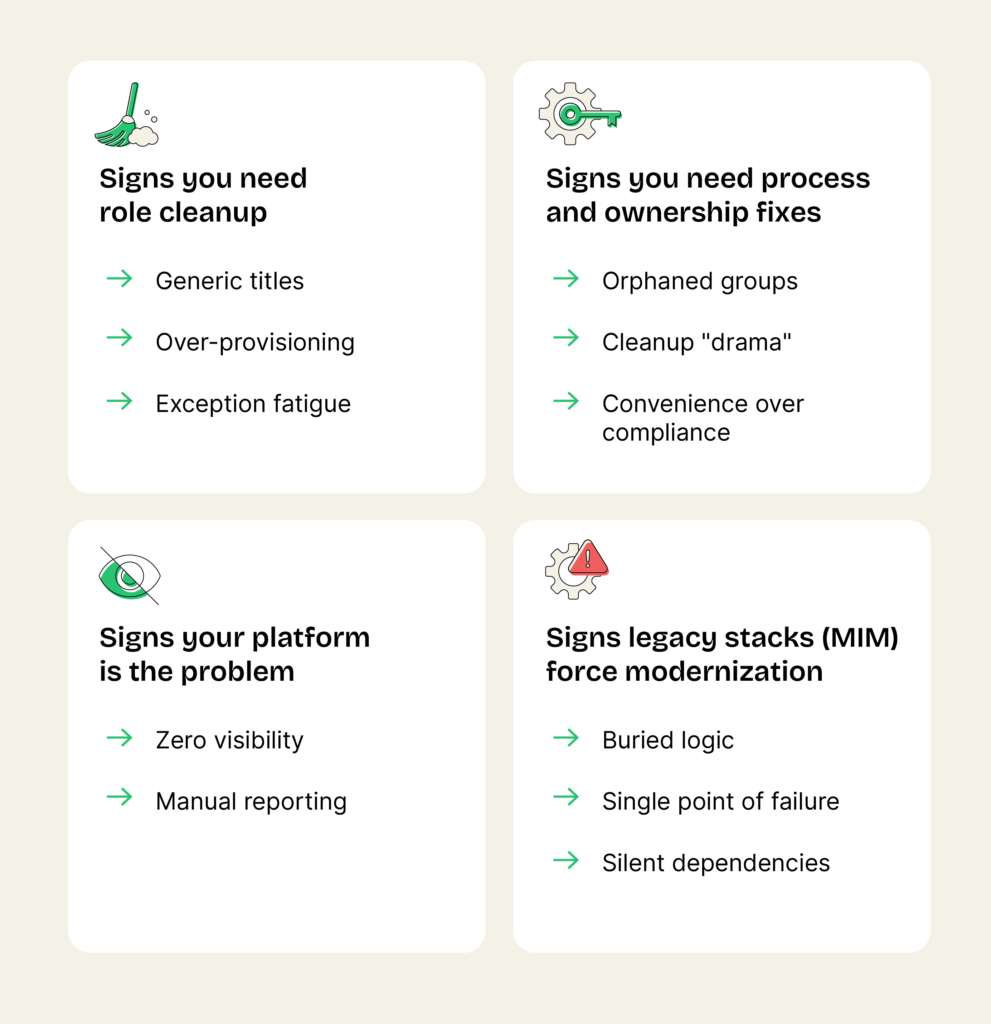
1. Signs you need role cleanup
- Generic titles. Users share broad titles (e.g., “Developer”) despite requiring vastly different technical tools.
- Over-provisioning. Access is granted to a team of 1,000 because two specialists needed specific permission.
- Exception fatigue. Manual requests and “out-of-bounds” exceptions are appearing more frequently than standard role assignments.
2. Signs you need process and ownership fixes
- Orphaned groups. You have thousands of groups or technical accounts, but only a fraction have documented owners.
- Cleanup “drama”. Reclaiming unused licenses or blocking inactive accounts triggers high-level organizational pushback rather than being a standard security procedure.
- Convenience over compliance. High-risk practices like leaving accounts active during long leaves are maintained solely to avoid the “hassle” of re-provisioning.
3. Signs your platform is the problem
- Zero visibility. You cannot instantly see “Access Origin” (why a user has a permission) or generate an “Out-of-Bounds” report without manual data extraction.
- Manual reporting. Compliance reports require fragmented database exports rather than being available “out of the box.”
4. Signs legacy stacks (MIM) force modernization
- Buried logic. Critical identity logic is “hard-coded” into AD attributes or scripts that no one currently on the team understands.
- Single point of failure. The system is a “black box” managed by one Principal Engineer [GU3] whose departure would leave the firm in a state of total knowledge loss.
- Silent dependencies. You are afraid to migrate or block accounts because systems have communicated silently for 15 years, and no one knows what might break.
What better tooling changes, and what it does not
Modern Identity Governance and Administration (IGA) tools move away from the “black box” nature of legacy systems by providing native, automated visibility. Tools like One Identity or Entra allow you to instantly identify “Access Origin” – showing whether a user gained a permission through a specific role, a manual request, or a lingering exception. Unlike manual processes that lead to organizational “dramas,” these systems automate attestation and role enforcement by design.
However, the right solution depends entirely on your technical fit and internal maturity. If an organization is deeply rooted in Microsoft technologies and Active Directory, moving to One Identity or Entra often offers a much smoother transition than a high-complexity platform like SailPoint.
Process modernization: The DORA reality
Migration is the perfect opportunity to fix outdated habits that have become liabilities.
For instance, the common practice of leaving accounts active during long leaves for the sake of “convenience” is no longer just a security risk. It is now a compliance failure. Under regulations like DORA (Digital Operational Resilience Act), financial entities must implement strict access controls and identity management to ensure resilience. This includes:
- Automating lifecycle management. Ensuring accounts are locked or permissions revoked when users are inactive or leave the organization.
- Segregation of Duties (SoD). Using IGA tools to prevent and flag conflicting permissions automatically.
- Audit-ready reporting. Moving from manual spreadsheets to “out-of-the-box” analytics that prove who has access and why.
Ultimately, tools are only as strong as the governance behind them. The IAM team must remain the “gatekeeper,” ensuring that application owners cannot bypass the system to add roles manually. If you simply move a broken, manual process to a modern platform, you haven’t fixed the problem, but made it more expensive.
Access governance is not a one-time design exercise
Access governance fails because it is often treated as a finished project rather than a living control system. In large enterprises, frozen role diagrams cannot keep pace with operational reality. Static models inevitably decay into a “black box” of undocumented logic and orphan accounts.
True resilience requires shifting from one-time design to active oversight. If your access model no longer reflects daily operations, a diagnostic review is the essential first step.
Assess your current drift today to determine if you need a targeted role cleanup, a governance redesign, or full platform modernization.