


The current conversation around AI focuses heavily on capabilities, i.e., what these models can build, write, or automate. But direct experience shows a different reality on the ground. The main problem that must be addressed is control.
When observing teams integrating these tools, the primary concern rarely centers on hallucinations or poor output. The actual anxiety comes from uncontrolled actions. Security practitioners are realizing that current systems often force an all-or-nothing approach. Either granting full, unrestricted entry to production systems or blocking the tool entirely.
Right now, the industry lacks established best practices for AI agent access. Standard operating procedures do not exist yet because the technology is too new. Security frameworks develop through trial, error, and shared experience.
In a nutshell
- AI agents shouldn’t get all-or-nothing access – the fix is least privilege with just-in-time permissions that expire the moment a task ends.
- The real risk is standing permissions: an agent’s behavior depends on context and reasoning that shifts task to task.
- 91% of organizations have adopted AI agents, but only 10% have governance policies in place (Okta, 2025).
- AI agent ownership needs three separate layers – business, operational, and risk – not one single owner.
- If agents are already in production with broad access, start with a full inventory before stripping anything away.
When AI agent access costs more than it’s worth
Many organizations are hitting a financial reality check. The cost of API tokens and heavy infrastructure is climbing. When calculating the actual return on investment, the math often falls short. Spending $30,000 to $100,000 on complex AI compute power rarely justifies the output when a skilled developer can build a more reliable, secure, and predictable solution for a fraction of that cost.
In fact, that’s something I’ve recently heard being confirmed by David Heinemeier Hansson, creator of the Ruby on Rails and Co-Founder of 37Signals. While experimenting with AI on complex code on a new project, he discovered that people did their work more efficiently 95% of the time.
Instead of rushing into direct integration, the smart move right now is caution. Experienced teams are already placing a strict control layer between autonomous agents and core systems rather than handing over the keys to the kingdom.
The “just give it access and see” problem
AI agents have moved well beyond chat. Today, developers connect them to CRMs, databases, ticketing systems, internal documentation, and production environments so they can complete work instead of just answering questions.
The problem is that many teams treat AI agent setup as a speed exercise. If broad credentials make the agent work faster, they grant broad credentials. Discussions across developer communities show that people follow the same path – they connect the agent to every tool it needs, test that it works, and worry about governance later.
That mindset becomes even more common in B2B SaaS. Companies race to ship AI-powered features while security models struggle to keep up. Individual users do the same when they connect AI agents to tools like email, Slack, Google Drive, or GitHub. Few stop to ask whether the agent really needs permanent access to everything.
How AI agent access differs from human access
Traditional IAM was built around people and predictable service accounts. They have stable identities, well-defined permissions, and relatively predictable behavior. AI agents don’t usually meet these criteria.
An AI agent isn’t just another chatbot, it:
- reads documents,
- queries databases,
- updates records,
- creates tickets,
- triggers workflows,
- and interacts with multiple systems in a single task.
Functionally, it behaves much more like another employee than a software integration.
The difference is that an employee pauses between actions, while an agent doesn’t. It can execute hundreds or thousands of operations continuously, without waiting for human approval between each step, and that’s what changes the entire risk model.
From my perspective, the biggest mistake is giving agents the same standing permissions we give traditional service accounts. I might trust a carefully tested API that has permission to delete database records because its behavior stays deterministic. I wouldn’t give those same permanent permissions to an AI agent. Its decisions depend on context, prompts, retrieved information, and reasoning that can change from one task to the next.
How should AI agent permissions work, then?
I believe they should change dynamically based on the task at hand. The hard question is who decides what the agent can access at any given moment. Another supervisory AI might eventually make those decisions, but as far as I’m aware, the industry hasn’t proven that model yet.
The challenge we’re looking at here is that AI agents introduced a completely new type of identity. A non-human identity may exist for only a few minutes, complete one task, and disappear. Modern platforms already create these identities automatically, and large deployments can generate thousands of new service principals every week. Analysts expect organizations to manage billions of AI agents within the next few years, making manual reviews impossible.
Existing IAM processes simply don’t scale. The familiar workflow of requesting access, approving it, provisioning credentials, and reviewing permissions periodically assumes long-lived accounts. That model wasn’t designed for short-lived AI agent identities that appear and disappear continuously.
The operational trap of reusing the creator’s credentials
A common shortcut teams take is allowing the agent to operate using the creator’s credentials instead of implementing proper identity separation. That means every user interacts with downstream systems using the creator’s permissions rather than their own. If the developer has access to a restricted SharePoint library with tens of thousands of confidential documents, the agent may expose that same data to every user who interacts with it.
Traditional role-based access control doesn’t recognize this pattern because authorization happens against the agent’s identity instead of the person who initiated the request.
The over-permissioning trap (and how organizations fall into it)
When teams deploy AI agents, a common misstep often includes reusing existing service accounts or granting broad access privileges just in case a tool needs them. This mirrors how some teams manage human permissions. Unfortunately, some people treat permissions as a minor technical detail during setup rather than a critical governance decision.
This approach triggers immediate AI agent permission sprawl. When a demo fails due to a missing credential, the team expands the scope. Every successful test adds another permission. Teams rarely remove access rights later because no one knows exactly which ones the agent still requires. Security debt accumulates without anyone noticing, creating an over-privileged AI agent.
Only 10% of organizations have AI agent governance policies
Industry data points to a severe governance gap. While 91% of organizations adopted AI agents, a mere 10% actually put governance policies in place to manage them. Security frameworks simply fail to keep pace with deployment.
The core issue comes down to a lack of proper monitoring and emergency stop processes. From my experience, most setups lack a clear “red button”, i.e., a reliable way to halt an agent immediately if it behaves unexpectedly. Safe deployments require a system that forces the agent to pause and ask for human confirmation before it executes a command.
A comment from a recent security discussion on Reddit sums up the situation really well: organizations routinely restrict access for junior developers, yet they turn around and grant unrestricted entry to autonomous AI tools. Applying least privilege AI principles means treating these agents with the same strict boundaries used for any human teammate. Implementing rigorous agent access control ensures these tools remain safe, accountable, and predictable.
Many of the same legacy assumptions show up in traditional identity platforms, too – see how legacy identity management systems like Microsoft Identity Manager are running out of road for exactly this reason.
Rethinking least privilege for autonomous tools
Applying the principle of least privilege to an AI agent requires a serious change in mindset. Traditional setups rely on static, permanent permissions. If you apply that rigid framework to an autonomous tool, you end up with two broken scenarios. Either the agent is too restricted to function, or it gets sweeping, unrestricted access just in case it needs to complete a task.
The concept absolutely still applies, but the implementation must change. Instead of asking what data the agent needs permanent access to, the question must be: what access does this specific execution require to complete this exact task?
This shift moves organizations toward dynamic, just-in-time access. The agent retains zero permanent privileges. Instead, it requests access for the duration of a task, provides a verifiable reason, and loses that access the moment the job finishes.
What is “blast radius” for AI agents?
When specifying a perfect, minimal set of permissions upfront is impossible, the strategy must pivot to damage control. The focus changes from absolute prevention to strict containment. Rather than trying to predict every single action, focus on a different metric: how much damage can this agent cause if it fails or suffers a compromise? If the worst-case scenario is unacceptable, the boundaries are too wide.
Furthermore, access boundaries directly impact how an agent thinks. If a tool pulls sensitive, unrelated data into its context window, that information alters its reasoning process. For example, if a sales assistant agent accidentally reads confidential legal notes about a client, it will alter its negotiation approach based on that data, even if it never explicitly quotes the files. Data access is also reasoning access.
Operationalizing AI agent governance
If you want to build a practical strategy around AI agent governance you’ll need the same operational rigor that you use for employees, vendors, and contractors.
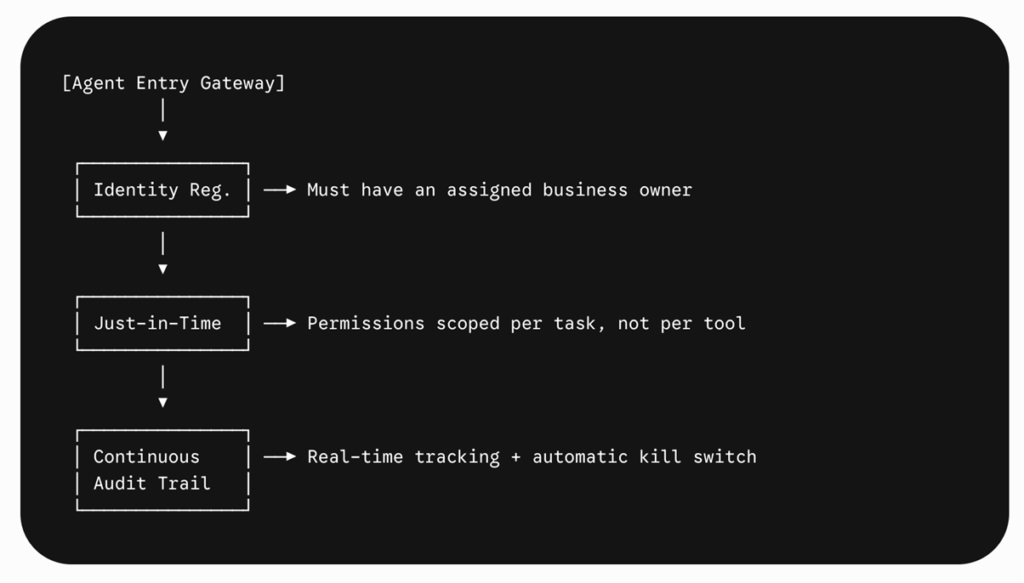
Securing these tools today depends on specific, repeatable processes:
- Agent Identity Management. Every agent must enter the ecosystem through a formalized onboarding workflow. Organizations must register them as first-class identities with assigned business owners, rather than letting developers deploy them ad-hoc via shared API keys or secrets.
- Clear accountability. Developers build and test the application, but the business unit deploying the tool owns the ultimate risk. If a system misbehaves, accountability falls on the business owner who signed off on the operational boundaries and test cases.
- Continuous monitoring. Maintaining a detailed AI agent audit trail is mandatory for tracking actions across systems. Every architecture requires a centralized kill switch to instantly terminate access if an agent deviates from its safe baseline.
- Regular access reviews. Security teams need to establish a routine agent access review process. This means answering explicit questions, like, Who signs off on new capability requests? Who reviews access modifications? Who is identifying and decommissioning dormant agents?
Treating least privilege access AI agents as an ongoing operational discipline, rather than a one-time configuration chore, is the only way to keep company systems secure.
Not sure your current access model can handle this? Talk to our IAM consulting team about reviewing your agent permissions.
The question is who owns access, not whether to give it
Naturally, the discussion shouldn’t revolve around whether to give an AI agent access. If the agent needs to complete real work, it will need access to systems and data. The real question is who owns AI agent access once that happens.
I look at AI agents the same way I look at any business application. A developer builds it, tests it, and hands it over. From that point on, the people who rely on it become responsible for its business purpose. Developers shouldn’t own production decisions forever simply because they wrote the code.
The mistake many organizations make is looking for a single owner. That rarely works. AI agent ownership should have three different layers:
1. Business ownership.
Someone needs to define why the agent exists, who it serves, and what it should never do. That person approves changes to the agent’s scope and decides when the agent no longer has a valid business purpose. They don’t own the technology. They own the justification for its existence.
2. Operational ownership.
This usually belongs to a developer, platform team, or AI operations team. Their job is to keep the agent running, maintain its integrations, review its permissions, and investigate unusual behavior. They maintain the system, but they don’t decide what the system should do.
3. Risk ownership.
Every agent can affect different assets, processes, and regulatory requirements. Someone needs to understand those risks and decide whether the organization’s risk tolerance matches the agent’s capabilities. Depending on the use case, that could be a security architect, a data owner, or a compliance lead. Agentic AI accountability only works when someone explicitly owns the consequences if the agent makes the wrong decision.
This same ownership debate plays out in identity governance more broadly – we unpack it in: Who owns identity governance: HR or IT?
What if you already deployed agents with broad permissions?
I wouldn’t start by removing access, but with an inventory.
Document every agent. Record what systems it can access, what permissions it has, who built it, who uses it, and who owns the underlying business process. Then identify the risks – you should start reducing permissions only after you understand what you have.
The inventory itself often delivers a huge value. It forces the organization to stop relying on assumptions and look at reality. You can decide:
- Which agents actually run in production?
- Which ones still have broad permissions?
- Who takes responsibility for them?
Those answers matter much more than another policy document.
Ownership depends on how the agent is used
One more issue deserves immediate attention: personal productivity agents built outside any approval process. These are quite common in business these days.
When organizations struggle to identify the owner of an AI agent, I like to ask a simple question:
Who would you hold responsible if that agent caused a serious incident tomorrow?
The answer usually points you to the real owner.
That question also reveals an important distinction between two types of agents.
The first category includes personal productivity agents. Employees build these for themselves, often using their own accounts and permissions to automate repetitive work. I’m skeptical of these in enterprise environments. People frequently have access to information they shouldn’t expose through an autonomous system. Sometimes those permissions are appropriate for the employee, but not for software acting on their behalf. The employee may never misuse that access, but an AI agent might. That’s how shadow AI becomes a security problem.
The second category includes agents that support business processes. These usually connect to applications and systems that already have clear business owners. In those cases, the agent shouldn’t create a new ownership model. It should inherit the existing one. If an application, process, or dataset already has an owner, the AI agent operating within that process should follow the same structure.
This distinction also changes how I respond when I discover an unmanaged agent. If it’s a personal productivity agent, I’d suspend it until someone reviews it. If it’s part of a production workflow, I wouldn’t disable it immediately because that could disrupt critical business operations. I’d first identify the business owner, document the current state, assess the risks, and then redesign the permissions.
AI agents can automate work, but they can’t automate accountability. Someone still needs to own the outcome.
Start with an inventory
The excitement around AI agents is justified. They can automate work that used to take hours and point us towards entirely new ways of operating. But that excitement shouldn’t distract us from the risks. At least for now, they introduce a level of uncertainty that may exceed anything we’ve dealt with in enterprise IT before.
If I had to name just one thing worth doing today, it’s taking inventory.
List every AI agent running in your organization. Find out what systems it can access, what permissions it holds, who owns it, and whether those permissions still match its purpose. Most organizations will discover agents with broader access than anyone realized.
AI agents will only become more capable. The sooner you understand what they can do inside your environment, the easier it will be to keep innovation and security moving in the same direction.
If you’re not sure where to start, or you want to understand whether your current access management model is ready for AI agents, schedule a free assessment call with our IAM team.
We’ll be happy to help you assess your environment, identify potential risks, and build an approach that supports AI adoption without compromising security.
FAQ
What is “least privilege” for AI agents?
Least privilege for AI agents means a move away from permanent, always-on access. Instead of a constant connection to entire databases, the system grants temporary access for a specific task. The agent asks for access to do a precise job, proves the need, and loses those privileges the moment the work finishes. This setup also limits what data the agent can see so it does not draw incorrect conclusions from unrelated information.
Who is responsible for an AI agent’s permissions?
Developers build and test the technology, but the ultimate responsibility sits with the business leader who deploys the tool. The business owner signs off on the operational boundaries and accepts the risks. If an agent makes an unauthorized system change, accountability falls on the head of that department, not the engineering team.
What happens if an AI agent is over-permissioned?
An over-privileged agent creates a serious, hidden safety risk. If the tool misinterprets a command, faces a prompt injection attack, or suffers a breach, it can execute harmful actions across core systems. Without strict boundaries, a simple error can lead to data leaks or accidental deletions – all at machine speed without a human confirmation gate or an emergency stop button.