
Most discussions around MIM migration failure reasons focus on API incompatibilities or sync errors, but the reality is far more human. While IT teams are aware that the 2029 end-of-life is approaching, many are stuck in a state of stagnation – acknowledging the deadline but failing to treat it with the necessary urgency.
In my experience, the true Microsoft Identity Manager migration challenges are rarely technical. Projects collapse because of ownership disputes between departments, decades of undocumented business logic buried in “black box” systems, and deep-seated change fatigue. With complex migrations requiring 12–24 months, the window for a successful transition is narrowing. If the organizational foundation isn’t addressed first, the most sophisticated technical runbook won’t save the project.
In this article, I will pull back the curtain on the hidden organizational traps that derail these transitions and share a practical, expert-led roadmap for navigating the journey toward a post-MIM future.
In a nutshell:
- Most MIM migrations fail because of organizational issues – not technical limitations.
- Undocumented business logic, unclear ownership, and years of technical debt are the biggest obstacles to a successful migration.
- Treat discovery as the first phase: audit your MIM environment before evaluating replacement platforms or vendors.
- Separate migration from modernization to avoid scope creep, delays, and budget overruns.
- With MIM reaching end of support in 2029, organizations that start planning early will have the best chance of completing a controlled, low-risk transition.
The clock is already running – and most teams don’t know it
Microsoft has confirmed that extended support for Microsoft Identity Manager (MIM) officially ends on 9 January 2029. While that date still feels comfortably far off, the reality of a modern identity migration tells a different story.
Microsoft is already actively encouraging organizations to begin planning now, saying that these transitions are rarely just a software swap. Because MIM often sits at the heart of an infrastructure – carrying years of custom sync rules, complex connector logic, and deep business-process dependencies – a successful exit is a multi-year marathon.
Starting early is the only way to safeguard against compressed timelines and the inevitable scarcity of skilled consultants as the deadline nears. Waiting until the last minute only eliminates the luxury of time needed to handle the unexpected. There is also a quiet crisis of disappearing institutional knowledge. Many engineers who originally architected these environments have moved on, leaving behind “black box” systems that no one truly understands.
The invisible inventory gap
A recurring pitfall happens when organizations rush into tenders for new Identity Governance and Administration (IGA) solutions without first auditing the current state. In one case at a major bank, the security department started a migration with a surprisingly “frivolous” approach. They focused entirely on the shiny new target state while remaining blind to the logic actually running inside the legacy system.
When a team cannot define what MIM actually does, the project inevitably stalls. This often leads to a costly “double-spend” where a new product is implemented, yet MIM stays active indefinitely because no one knows how to safely untangle it. Companies end up with two products running side-by-side and a failure to actually retire the legacy system.
To avoid this, I recommend starting with a detailed audit. Also, ask your internal team: who truly owns the logic inside MIM? A delay in that answer is the first red flag that MIM end of life 2029 planning is already behind schedule.
The real problem – MIM knows more than anyone admitted
A typical MIM instance is a living archive of 10-15 years of business decisions that nobody ever wrote down. Over a decade, these environments accumulate a massive layer of custom sync rules, bespoke workflows, and connector logic. Often, the architects who built these solutions have long since moved on.
The technical debt inside a mature MIM deployment is rarely visible on the surface. What looks like “simple synchronization” from the outside is often a complex web of organization-specific logic enforcing policies that have never been formally captured in a document. This hidden layer is the primary driver of identity management migration complexity, turning what should be a technical upgrade into a forensic investigation of legacy business rules.
Your MIM instance is an iceberg
From my experience, one of the most common mistakes is starting with a platform choice rather than discovery. Organizations sign a contract for Entra ID or a third-party IGA tool, only to realize mid-migration that their legacy HR integration is held together by a custom PowerShell script that no one knew existed.
A “lift and shift” approach fails because teams discover too late that they don’t understand what MIM is actually doing, they only know that things break when it stops. Real-world patterns show that a proper discovery phase often uncovers three times more dependencies than the initial scoping assumed. This is why a planned 12-month project can easily morph into an 18–24-month ordeal.
Deep discovery must be the first phase of any credible migration. Without it, there is a high risk of being stuck in a “permanent pilot” phase, where the new system is live but cannot actually replace the old one. To get ahead of this, start by uncovering those undocumented manual exceptions and hidden scripts today. Waiting until the contract is signed is already too late.
The organizational failure modes nobody talks about
Identity projects are unique because they sit at the intersection of HR, IT, Security, and Compliance. However, in most organizations, no one truly “owns” the data flow between them. While HR departments have their own systems, they are often reluctant to get involved in the technical plumbing. The friction is even more intense at the junction of IT and Security, where competing priorities can lead to a total standstill.
This lack of clear leadership is a primary driver of IAM migration project failure. I’ve seen projects started by IT that stall the moment they hit HR data quality issues. When neither side is held accountable for the “truth” of the identity data, the project dies in a graveyard of unanswered emails.
Pattern 1: The overconfidence trap and the “detective” phase
In my experience, a recurring mistake is treating MIM with a certain level of dismissal, as “just a legacy tool.” This overconfidence is dangerous. Because MIM is often a “black box” where no one quite knows what is happening under the hood, underestimating its complexity is the fastest way to blow a budget.
This is compounded by a chronic lack of “as-is” documentation. Most organizations might have a design document from the initial implementation phase, but after a decade of hotfixes, that document usually has nothing to do with reality. I often find myself playing detective, performing deep reverse engineering just to understand how a user actually gets an account. Without a clear map of the current state, any move to a new system is just a guess.
The myth of the steering committee
Recent research confirms that without a named executive sponsor, enterprise projects are significantly more likely to fail. A “steering committee” isn’t enough; a single leader is needed with the authority to clear political roadblocks and make definitive cross-departmental decisions.
In inter-departmental conflicts, there are no winners. When IT and Security pull in different directions, the result is a solution that either lacks critical features or simply doesn’t work. I always tell my clients that you cannot “win” an argument against another department in an identity project because the goal is to find a common language and a shared plan.
To succeed, IGA implementation organizational change must be treated as a team sport. This includes everyone from HR and IT to the external vendor. Everyone has to play for the same goal, or the result is a fragmented system that satisfies no one and leaves the organization vulnerable.
Expert takeaway: If a project lacks a sponsor who can break a stalemate between HR and IT (or other departments), the migration is over before it begins. Because instead of building a system, you’re managing a deadlock.
Pattern 2: The scope that eats itself
MIM migrations have a peculiar habit of attracting scope creep. Because the system has been in place for so long, stakeholders often view the migration as a “once-in-a-decade” opportunity to fix every lingering identity issue at once. Suddenly, a platform migration morphs into a full IGA transformation, including role modeling, access certification, privileged access, and cloud SSO.
The danger here is that while the ambitions grow, the budget and timeline usually remain rooted in the original “simple migration” estimate. This is where I see projects start to buckle under their own weight.
The “migration” vs. “modernization” trap
Recent research from Prosci shows that organizations allocating roughly 10% of their project budget to structured change management see significantly higher success rates. In the world of MIM, however, change management usually receives less than 5% of the attention. Teams focus on the “how” of the technology and ignore the “who” of the user adoption and stakeholder buy-in.
To keep a project from collapsing, I advocate for a ruthless separation:
- Phase 1: Migration. Replicate the current-state capabilities on the new platform. Get the foundation stable.
- Phase 2: Modernization. Improve the processes, redesign the roles, and add the bells and whistles.
How often does the scope change?
I am often asked how often an initial scope estimate changes once we actually get inside a MIM instance. My answer is always: it depends on the complexity, but you must be prepared to pivot.
While about half of the environments I encounter are “friendly” – meaning they have a medium level of complexity that is relatively easy to parse – there is a significant percentage that are incredibly intricate. I have seen instances with over 60 agents and hidden side-processes where no one knows what is happening.
Because of this, I never treat an initial estimate as gospel. In my practice, the discovery and analysis phase always ends with a formal re-evaluation. Once we’ve done the “detective work” to uncover the undocumented scripts and systems, we check to see if the valuation still aligns with reality. If you don’t build this re-evaluation point into your project plan, you are setting yourself up for a nasty surprise mid-way through implementation.
Expert takeaway: Don’t try to fix ten years of bad process debt while simultaneously changing your entire identity platform. Move first, then improve.
Pattern 3: The change fatigue spiral
MIM touches every employee – from password resets to the onboarding of new hires. When a cutover falters, user trust disappears instantly. Recent data suggests that 64% of employees are already overwhelmed by organizational change. In an identity context, this fatigue manifests as resistance and shadow processes that can take six months of firefighting to repair.
Success is rarely just about the code. I can usually spot whether a project will succeed in the first week by looking at two aspects. Technically, a “first look” at the environment tells me if we are facing a simple hill or climbing Mount Everest.
Psychologically, the interaction with the client team is even more telling. If the project was started by IT in a vacuum without senior management truly convinced of its necessity, we spend more time justifying our existence than delivering results. Success requires a collaborative spirit; if there is no openness during the first few meetings, the human friction will eventually outpace the technical progress.
What a migration that doesn’t fail actually looks like
Here’s where strategy shifts from theory to execution. To ensure success, these four steps should be prioritized to build a foundation that survives the complexities of the transition.
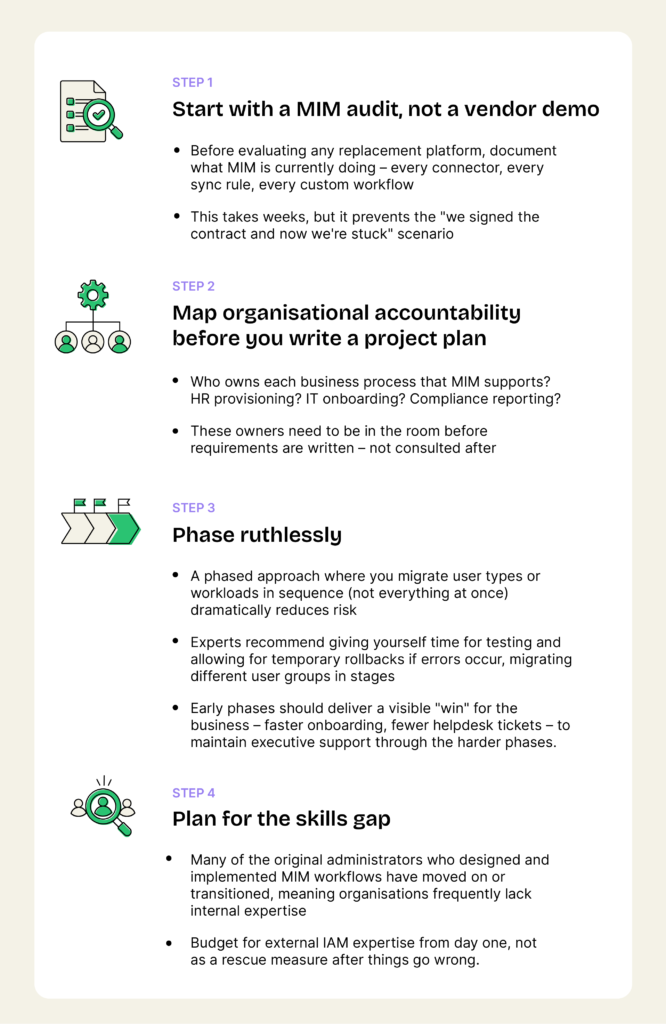
Step 1 – Start with a MIM audit, not a vendor demo
Before evaluating any replacement platform, document what MIM is currently doing – every connector, every sync rule, and every custom workflow. This takes weeks, but it prevents the “we signed the contract and now we’re stuck” scenario.
Step 2 – Map organizational accountability before you write a project plan
Who owns each business process that MIM supports? HR provisioning? IT onboarding? Compliance reporting? These owners need to be in the room before requirements are written – not consulted after. Securing MIM migration stakeholder buy-in at this stage ensures that when the technical hurdles appear, you have the political capital to clear them.
Step 3 – Phase ruthlessly
A phased approach where user types or workloads are migrated in sequence dramatically reduces risk. I recommend giving yourself time for testing and allowing for temporary rollbacks. Migrating different user groups in stages ensures that early phases deliver a visible “win” for the business – like faster onboarding – maintaining executive support through the harder phases.
Step 4 — Plan for the skills gap
Many of the original administrators who designed and implemented MIM workflows have moved on. Because organizations frequently lack this internal expertise, it is vital to budget for external IAM expertise from day one, rather than calling for a rescue measure after things go wrong.
The 2029 deadline is an organizational problem, not just an IT one
For regulated industries like finance, healthcare, and energy, running unsupported identity infrastructure post-2029 is a massive compliance and audit risk. If an IT Director treats this as a background task, they may eventually find themselves in front of a board explaining why their core security system is past its end-of-life.
The organizations that succeed are those where the CTO or CIO sponsors the migration as a strategic security initiative. My single piece of advice for any director starting tomorrow is to do your analysis. It is the foundation of everything. Without a deep understanding of the client’s expectations and the current state, a successful design is impossible.
Facing the true identity management migration complexity head-on is a boardroom-level priority. We are retiring critical security infrastructure on a fixed deadline; this requires budget, headcount, and cross-functional commitment starting now.
Not sure where to start? QWEY’s IAM assessment provides a clear picture of what your MIM environment actually contains and what a realistic migration looks like for your organization. Get in touch.